
First Person Shooter Benchmarks
Oh god, I can just see the onslaught of angry geek emails coming my way from the following statement. Anyhow, it goes without saying that 3D First Person Shooter (FPS) games are the de facto standard for system benchmarking. They tend to push your system to its limits in both processing and graphics rendering. For our FPS testing we picked two titles that have the most realistic benchmarks built in. One is a fairly punishing DX9 title, and one is the DX10 title know to make even the most burly (an expensive) computers cry for mercy.
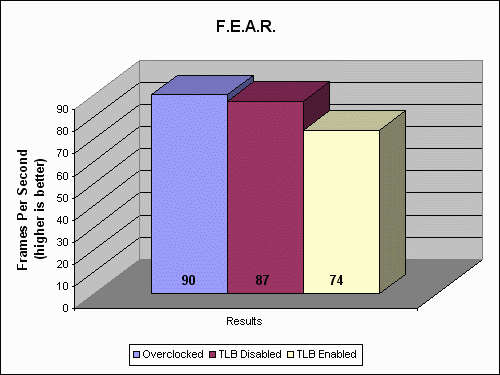
F.E.A.R. was released in 2005, and still to this day it can test a system to see what it’s made of. For our testing purposes we maxed out all the settings, dialled the anti-aliasing up to 4x and anisotropic filtering up to 8x, and set the resolution to 1680×1050. We then ran the internal benchmark, which consists of a timedemo rendered in game. The benchmark was run three times, and the average was taken from all three scores.
Overclocking the Phenom 9600 Black Edition only resulted in an average performance increase of 3 frames per second (FPS), which with the applications of some more maths is only a 3% increase. The TLB erratum fix had a much more drastic effect in the opposite direction. Performance dropped 13 FPS on average when the fix was applied, which works out to a 12% decrease.
At the frame rates produced by F.E.A.R. in our test rig, these performance differences would not be noticeable. As long as the game doesn’t dip below 30 FPS your playing experience shouldn’t be affected. With that in mind, we move on to our next FPS title.
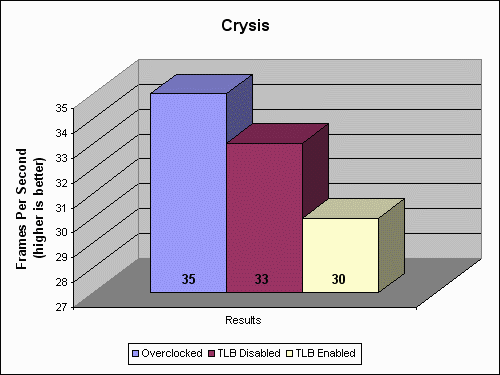
Crysis is the newest DX10 First Person eye candy fest. This game is thought of by many as the spiritual successor to Far Cry; the game that made performance computers and their owners cry throughout 2004. Like it’s predecessor, Crysis is known to bring even the most heartily equipped modern performance rigs to their knees. The game is a visual and auditory extravaganza that truly needs to be experienced. But enough of my fanboy gushing; there are benchmarks to be performed. For testing, we used the Crysis Benchmark Tool and ran the CPU test run. Unlike our previous benchmarks, we didn’t dare try to crank the Crysis benchmark settings to maximum. We used the high settings at a resolution of 1280×1024 with no anti-aliasing or anisotropic filtering. All tests were of course performed in DX10 mode.
At first glance, the numbers posted by our CPU time demo may seem like a small performance delta. There was only positive 2 FPS difference between overclocked and stock clocked, and a negative 3 FPS difference between TLB disabled and enabled. Even at those low numbers the results still work out to a 6% increase and a 9% decrease, respectively. As I had outlined before, when you are only averaging 30 FPS, every frame given or taken away really counts. This can be the difference between a minor lag where you only take a couple bullets before returning fire, and being dead.
Real-Time Price and Stock Check – Shop Like a PRO!